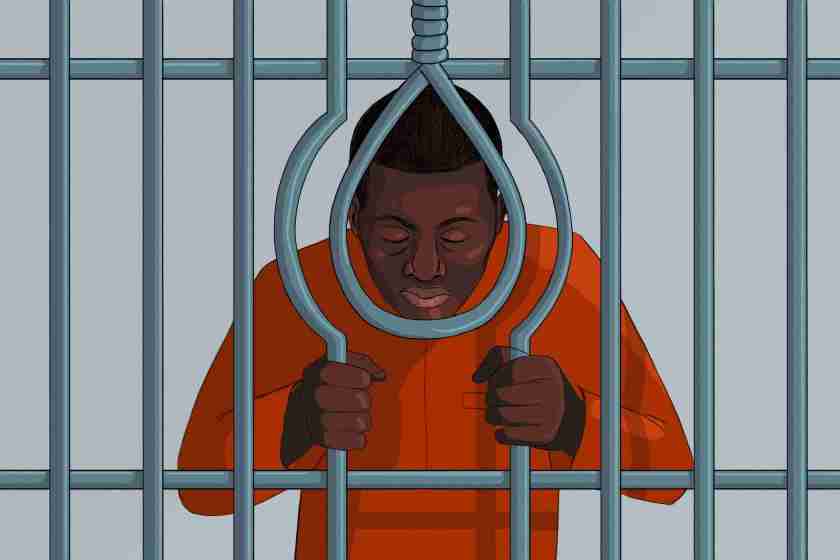
63% of Americans say the death penalty does not deter people from committing serious crimes. If all Americans are consistent, 63% of Americans do not believe demand curves slope downwards.
The law of demand says that there is an inverse relationship between the quantity demanded of a good and its price. A significant component of the price of a transgression like murder can be taken to be the product of the severity of the punishment and the probability of receiving the penalty.
Since Ehrlich’s 1975 seminal work claiming evidence of the deterrent effect of capital punishment, there have been legion papers asserting otherwise.
However, it is virtually certain a priori that the death penalty reduces murder, insofar as it is deemed a worse punishment than life imprisonment, which it generally is.
Some argue capital punishment will have no effect on the decision-making of potential murderers as they are heinously vicious criminals who won’t be stopped by the possibility of the death penalty. Homicides are crimes of passion and irrationality, so the deterrent effect is absent.
That’s like saying raising the price of Apple’s smartphones will have no effect on the decision-making of Apple fans as they are passionate fanatics who won’t be stopped by price signals. iPhone purchases are characterised by extreme zeal, so the law of demand does not apply.
These cannot be true as long as the demand for murder or iPhones is not perfectly inelastic, which means that not every prospective murderer is heinously vicious or iPhone buyer passionately fanatic to the degree that a change in price does not influence their quantity demanded.
In societies where murder or the threat of it is present, there will always be people at the margin. True, increasing the severity of the punishment will not deter every prospective felon, but we can be sure that it will deter some, so that consequently,we will see an aggregate reduction in crime or murder.
In societies where Apple consumers or potential ones are present, there will always be people at the margin. Granted, increasing the price of the product will not put off every buyer, but we can be sure that it will discourage some, so that as a result, we will see an aggregate fall in sales or iPhones.
People respond to incentives. It is incontrovertible that capital punishment deters murder, as long as it is perceived as a worse penalty than life in prison. The extent to which capital punishment reduces murder depends on the price elasticity of demand for murder, which is empirically determined. Ehrlich suggested that an additional execution “may have resulted, on average, in 7 or 8 fewer murders”, though he qualified that his prediction is “subject to relatively large prediction errors.”
I have avoided normative statements.
Extension
Is it possible to believe in the law of demand (downward-sloping) and that the death penalty does not decrease murder and be intellectually consistent?
Questions
How many homicides should an execution prevent for you to consider capital punishment conscionable?
Would you like to live in a society with capital punishment?
Extra
Some woke person may ask “Why did you choose a black person for the thumbnail?“
Would you have asked “why did you choose a white person” if the picture depicted a pale person instead? I chose the picture on the basis of its suitability to my theme, not on grounds of a specific skin tone. The person who created the picture may have thought the balance of colours in the picture is better with a dark-skinned prisoner. Maybe the artist is racist. Maybe there is an association of crime with blacks in the artist’s society.

 BLOGOPUS
One thought on “The Deterrence of the Death Penalty ☠️”