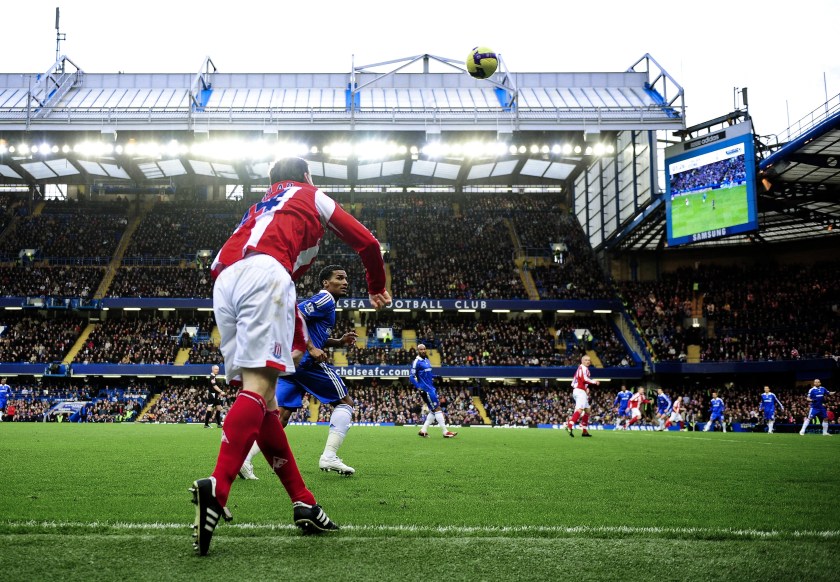
A few weeks ago, as I sat on my sofa watching the Premier League, an idea that may change football appeared in my mind. I forgot what match it was, but I remember I had the thought as I witnessed a throw-in being taken by a team in their defensive third. That team lost possession after a few touches.

Consider a team in possession, attacking towards the right-hand side. Under no pressure, the German maestro Toni Kroos sprays a long ball in the direction of the corner flag. Is he searching for Salah down the wing? Is Mbappe in acres of space down the left flank? Is Haaland hurtling down that area of the pitch? The ball hits the floor a dozen yards from the touchline and bounces one more time before exiting the pitch at a point 2 metres short of the corner flag. There are no players within a good 20-metre radius of that point.
Who gives the ball away like that? Why would you lose possession for no reason?
Reason
Throw-ins are much more limited in range compared to free-kicks, as players simply cannot throw that far. Therefore, when a team has a throw-in in their defensive third, the opponent side pushes forward and executes man-marking in the region of the throw-in. This cramps up space in that area of the pitch.
Generally two things occur from a throw-in deep in a team’s own half.
One, they clear the ball into the opponent’s possession. Safety first.
Second, they attempt to remain in possession. To do so, they have to control the ball and play it out successfully. But the receiving players of the throw-in cannot reliably control the ball and play it out as they are being closely marked and the ball has to be controlled from the air, adding to the difficulty.
As a result, possession from such throw-ins is often turned over to the opponent’s side.
And there is a good reason why they may now be in a good position to launch an attack.
As there is a throw-in near the corner of the pitch and man-marking takes place, the formations of both teams are distorted and not in their default set-ups. An optimal set-up is generally more critical for the defending side as organisation is more crucial for defence than for attack. With the defensive structure compromised, the attacking side (i.e. the initiator of the throw-in gambit who has now regained possession) can now better exploit spaces and make creative offensive plays.
Kroos wasn’t trying to pass to Salah, Mbappe or Haaland. And it’s not because they don’t play on the same team. Kroos was sending the ball over the touchline for an opposition throw-in, never intending for the ball to land at anyone’s feet.
In a typical football game, teams in possession spend a large part of the game playing passes around the backline and between the midfield, most of them going sideways or backwards. They move and pass the ball around from left to right, looking to break the opponent’s lines.
Such a time-consuming activity may be okay if your team has superior passers and is comfortably leading in a game, but what if you’re chasing a goal? What if you’re in injury time? What if this is a must-win game, or a knockout match? What if this is the World Cup final and your team is a goal down with 10 minutes to go? Is passing around the defence and midfield really the most efficient way to get goal-scoring chances?
The tactic of intentionally giving the opponent a throw-in deep in their half is a shortcut to go deep in the opponent’s half and cause them to break formation. It is a gambit that can result in a higher goal-scoring efficiency.
Nonetheless, I can think of at least one substantial reason why this tactic has not seen widespread adoption. It is supposedly “anti-football”. Fans get frustrated when their team “parks the bus” (play very defensively, preferring to let the other team dominate possession) or plays “route one football” (play long balls to forwards upfront, skipping the build-up phase). This gambit may be considered in the same light. Managers and players in top-level professional football are not purely results-maximising agents—they care about entertaining and pleasing their fans too. A large part of their wages comes directly from the fans after all.
But what about football competitions which are not dependent on fan revenue? Could this tactic be used in school football games?
Moreover, it is not implausible that this tactic would see not a drop, but a rise in attacking football. With the “passing-around” phase skipped, we could see a higher number of attack attempts. Entertainment is not necessarily undermined. Even if it is, I don’t see it as an issue. For me, entertainment is seeing teams and players do whatever is at their disposal in order to get results and win the game.
Another reason why the managers and players of a team are hesitant to use such an inelegant tactic is because they are averse towards derision by opponents, pundits and football fans. Nobody likes risking ridicule. For managers, it can be career suicide and an unwanted legacy. But if someone starts the ball rolling and the gambit becomes ubiquitous after an initial phase of contempt, this shortcoming can be overcome.
The tactic is especially useful for weaker teams playing against much stronger opposition. If you know you can’t outmanoeuvre Manchester City or Brazil through passing around, why not practise playing the ball to the corner flag for attacking training instead?
Such a tactic can be even more relevant in high-stakes knockout games, or games in general where there is a very strong must-win element. We may see this tactic in play during the World Cup next week, although I think it’s unlikely, since this gambit is hitherto totally unheard of conventionally. I’ll keep a look out for throw-ins deep in a team’s half during the World Cup matches to see if my theory of this tactic’s workability is feasible. It would be interesting to see how football evolves if this tactic becomes common practice.
On the other hand, maybe this is a completely absurd, unrealistic and far-fetched idea that would be laughed at by the likes of Guardiola and Klopp or even just the local football coach. Maybe they’ve thought of it before and are confident in the knowledge that it does not help in scoring goals, their certitude backed by statistics and computer simulations analysed by specialists. Anyway, this tactic is just a thought that occurred.
What are reasons against such a tactic—why it wouldn’t work, why it is inferior to conventional build-up play?
Research
Two days after I wrote the above, I searched for any data or research relating to my suggested tactic. The information I could find was almost non-existent but for this article, where “throw-in phases of play as exported from each of the 380 games during the 2018/2019 English Premier League season from the Statsbomb database” was analysed. A total of 16,154 throw-in’s were included in the sample. Throws-ins from injury clearances (i.e. possession freely given back to the opposition following the ball being kicked out of play due to an injury) are excluded.
This table is part of the study. Our focus is on the last 4 rows.

Critical cells:
| Segment of Pitch | % of Total Throws | % of First Contact Success | % of Possession Retained |
|---|---|---|---|
| Attacking 18 Yard | 15.0% | 86.0% | 62.8% |
| Rest of Attacking Half | 42.1% | 87.7% | 69.6% |
| Rest of Defensive Half | 36.4% | 78.3% | 65.0% |
| Defensive 18 Yard | 6.6% | 69.0% | 48.5% |
Points:
- Throw-ins in the defensive 18 yard have the lowest first contact success rate out of all throw-ins in the 4 segments of the pitch. This is how a successful first contact is defined: “A player from the same team which throws the ball into play makes first contact with the ball post throw-in without an opposition player making contact.”
- Possession is least often retained from throw-ins in the defensive 18 yard compared to those in other parts of the pitch. Possession retained is defined as the ball being “retained in possession for 7 seconds from the point in which the ball is thrown”.
- The defensive 18 yard sees, by far, the lowest proportion of throw-ins compared to other areas of the field.
The first two points evince that defensive 18 yard throw-ins make the team in possession significantly more vulnerable than throw-ins in the other portions of the pitch.
The final point indicates that teams have not been exploiting this tactic.
This is a relevant excerpt from the article that comports with my argument for the gambit:
As Siegle and Lames14 suggested, the team not in ball possession frequently sees a throw-in in the defensive area as an opportunity to conquer the ball and create pressure. A possible explanation is when throwing the ball forwards, the opposition are set up in a compact shape, outnumbering the attacking team with defensive players. This results in a ‘fight ball’ being thrown down the line into an unfavourable situation and therefore in a loss of first contact and ball possession retention. Furthermore, when throwing forwards the aim might be for players to head/flick the ball onto a teammate, however, as Szczepański and McHale22 demonstrate headed passes are less accurate and have a negative effect of the following pass, in comparison to those passed from the ground, hence might lead to a loss of possession.
Appendix
5 days after I initially wrote about this, I found another useful article that builds upon my stratagem. Though he doesn’t go so far as to suggest teams play the gambit in a discretionary way, the author recognises defensive throw-ins as offensive opportunities and scrupulously examines the tactics surrounding them.

 BLOGOPUS
One thought on “The Throw-In Gambit: Revolutionary Tactic Or Hogwash? 🏟️”